
Joana Kirilova
Bulgarian Drinking Culture - A Tourist's Guide (2026)
Bulgarian drinking culture runs on rakia, local wine and long toasts. Here's what tourists need to know before their first Nazdrave in Sofia.
You’re sitting at a table in Sofia. Someone hands you a small glass of clear liquid, raises theirs, locks eyes with you, and says “Nazdrave!” You have no idea what you’re drinking, why there’s a plate of white cheese in front of you, or why the whole table just went silent waiting for you to sip first. That’s the moment you realise Bulgarian drinking culture has actual rules - and you’ve already broken two of them.
This guide covers everything: the drinks, the etiquette, the toasts, and the traditions that make drinking in Bulgaria feel more like a ritual than a night out.
If you want to experience it all firsthand with a local guide, our Sofia pub crawl runs every Friday and Saturday at 9PM. For 21 EUR you get a welcome beer, three shots, VIP club entry, and four bars in one night. We’ve been doing this since 2014, so we know where to take you.

New to Sofia? Don't want to party alone?
Join the Original Sofia Pub Crawl!
Tour of the best bars in Sofia
Meet other travelers and expats
Free welcome shots in every bar
Rakia Is the National Drink (And Yes, You Have to Try It)
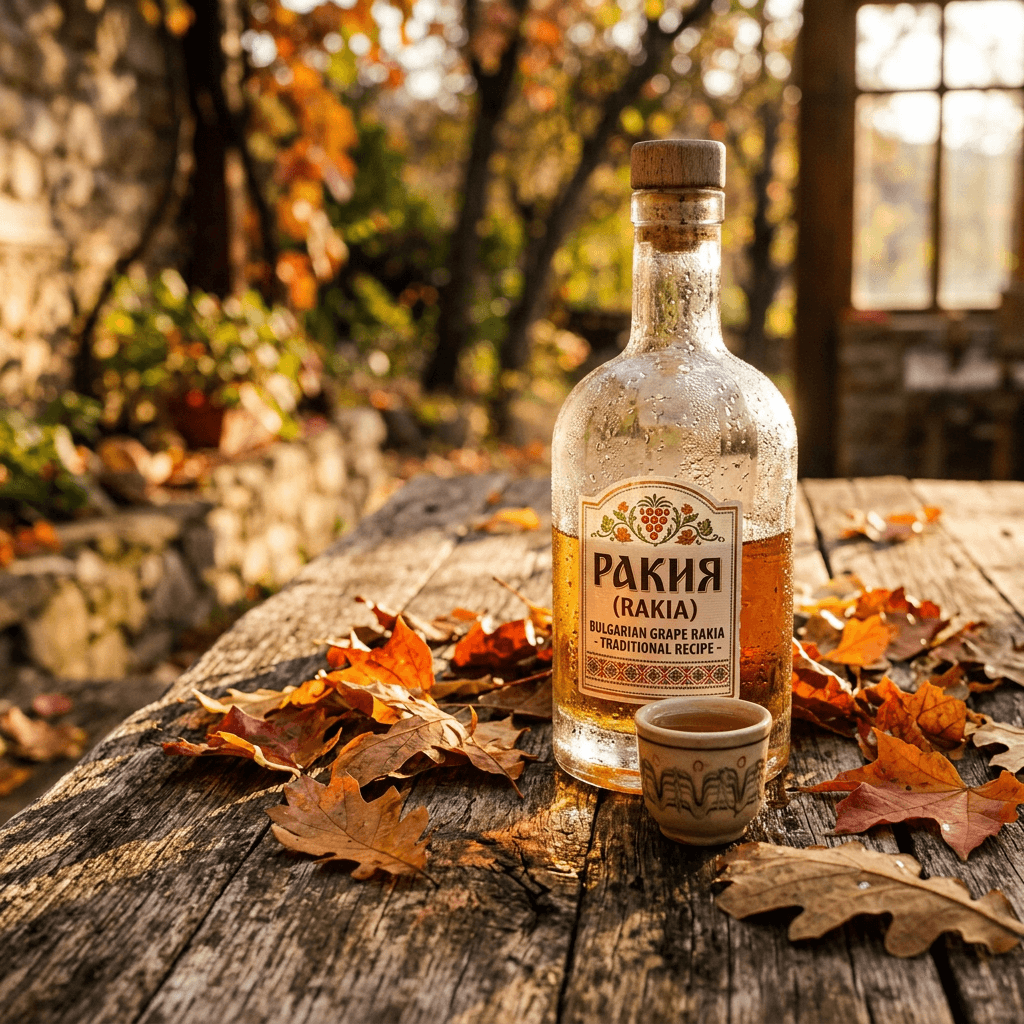
Rakia is to Bulgaria what whiskey is to Scotland or tequila is to Mexico - except Bulgarians take it more personally. Nearly every family in the countryside distills their own batch, and offering a glass of homemade rakia to a guest is considered the most basic form of hospitality.
The drink is a fruit brandy, typically distilled from grapes or plums, though you’ll also find versions made from apricots, pears, figs, and even quince. Store-bought rakia usually sits around 40% ABV. Homemade stuff? Often closer to 50-60%. Your Bulgarian host won’t warn you about that distinction. They’ll just refill your glass.
There’s a running joke that 30-40ml of rakia a day keeps the doctor away. Older Bulgarians say it with total sincerity. Rakia has been used for centuries as a folk remedy for colds, fevers, and general aches (mothers used to wrap their children in rakia-soaked bandages). Whether any of that works is debatable, but the tradition is real.
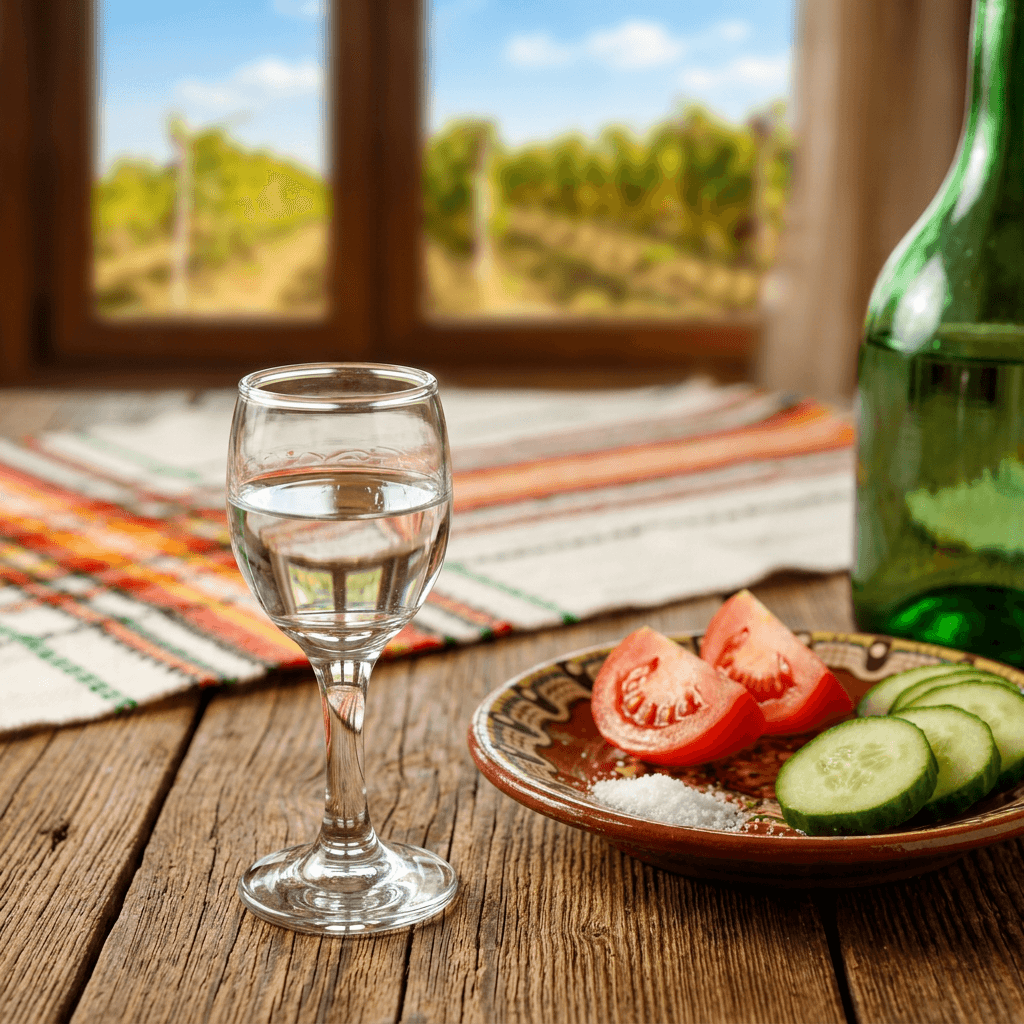
The proper way to drink rakia is slowly, sip by sip, never as a shot. Slamming it back is a fast way to lose credibility with locals. It’s always served alongside food - a shopska salad, some sirene (white brine cheese), lukanka (a dry-cured salami), or pickled vegetables. Bulgarians call this spread “meze,” and drinking rakia without it is considered borderline uncivilised.
In winter, look for “greyana rakia” - a heated version mixed with honey, sugar, and sometimes black pepper. It’s the Bulgarian answer to mulled wine, and it’s dangerously easy to drink on a cold January night.
Curious about what Bulgarian rakia really is and how it’s made? We’ve got a full breakdown. And if you want to taste multiple varieties in one sitting, we run a proper rakia and wine tasting in Sofia with a local guide.
The Toasting Rules You Need to Know
Bulgarians don’t just clink glasses and move on. Toasting here follows a specific ritual, and getting it wrong is noticed - even if nobody says anything to your face.
The word for “cheers” is Nazdrave (naz-DRAH-veh), which translates literally to “to your health.” You’ll hear it at every table, every round, every occasion. But saying the word is only half of it.
When you raise your glass, you must make eye contact with each person you’re toasting. Not a quick glance - actual, sustained eye contact as your glasses touch. If you’re at a table of six, that means six separate moments of eye contact. Skip someone and you’ve committed a minor social offence. Look at the floor while clinking? Even worse.
Your glass also needs to be full. Raising a half-empty glass during a toast is considered bad luck and a sign of disrespect to the person being toasted. Hosts will keep topping you up specifically so this doesn’t happen. Non-drinkers sometimes get politely pressured to at least hold a full glass of something - water, juice, anything - just so the toast can be “valid.”
Toasts also come with blessings. The simplest is just “Nazdrave,” but at dinners and celebrations you’ll hear longer versions: wishes for health, happiness, prosperity, and grandchildren. At name day celebrations, the traditional wish is “Da ti e zhivo i zdravo imeto!” - “May your name live on and be healthy.”
Bulgarian Wine Has Thousands of Years Behind It
Bulgaria doesn’t get the same wine press as France or Italy, but it should. The Thracians - the ancient civilisation that inhabited this land - were cultivating grapes and producing wine more than 3,000 years ago. The Greek god of wine, Dionysus, was actually a Thracian deity first. This isn’t a country that recently discovered winemaking. It’s one of the places where European wine culture began.
During the communist era, Bulgaria was the world’s fourth-largest wine exporter. That collapsed after 1989 when the industry was privatised and many vineyards were abandoned. But in the last two decades, a new generation of winemakers has been rebuilding - planting modern wineries, experimenting with indigenous grape varieties, and producing wines that are winning international awards.
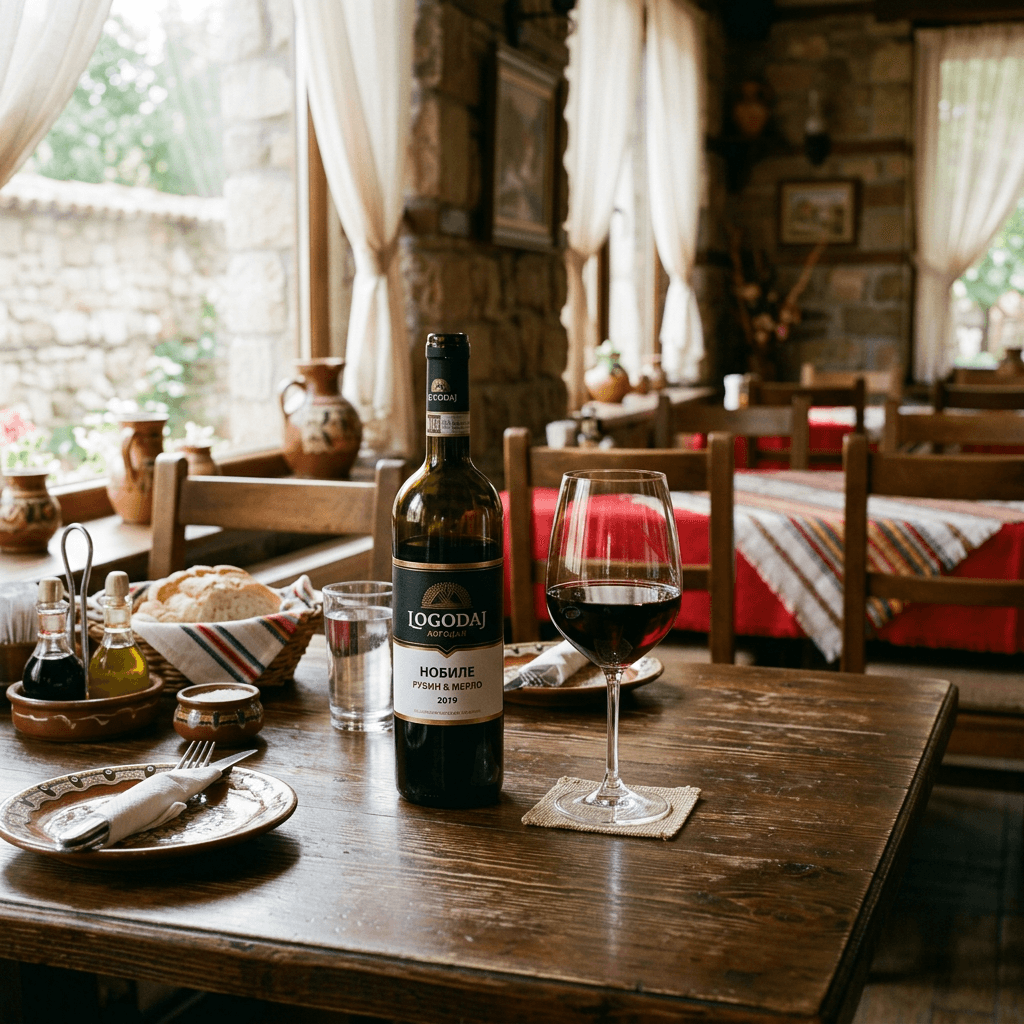
The grapes you need to know are the local ones. Mavrud is the flagship red - a full-bodied, tannic wine with deep blackberry and prune flavours. It’s grown primarily around Plovdiv and Asenovgrad, and a good bottle of Mavrud can stand next to any mid-range Malbec. Broad-Leafed Melnik comes from the warm Struma River Valley near Greece and produces age-worthy reds with notes of cherry, tobacco, and leather. Winston Churchill allegedly had 500 litres of Melnik wine shipped to him annually.
For whites, Dimyat is the most widely planted indigenous grape - light, aromatic, with peach and apricot notes. It’s perfect for summer drinking. Misket (specifically Red Misket) is misleadingly named - it’s a white wine from a pinkish grape, dry and floral, similar to a Moscato but without the sweetness.
Then there’s Rubin, a uniquely Bulgarian grape created by crossing Syrah and Nebbiolo in the 1950s. The result is a dark, tannic red that softens beautifully with age.
You can explore these wines at any serious restaurant in Sofia, but if you want a guided introduction, our rakia and wine tasting covers the best of both worlds.
Trifon Zarezan: The Day Bulgaria Drinks Wine Instead of Celebrating Valentine’s Day
February 14th means something very different in Bulgaria. While the rest of the world exchanges heart-shaped chocolates, Bulgarians celebrate Trifon Zarezan - the feast of St. Trifon, patron saint of vineyards, winemakers, and innkeepers.
The tradition has roots in ancient Thracian worship of Dionysus. On this day, vineyard owners perform the year’s first symbolic pruning of the vines, then sprinkle wine on the soil as a blessing for a good harvest. A respected local winemaker is crowned “King of the Vineyard,” has a vine wreath placed on his head, and is paraded around the fields. After the ritual, the real business begins: eating, drinking, and dancing - often for the rest of the day.
In recent decades, younger Bulgarians have started celebrating Valentine’s Day too, so February 14th has become a dual holiday. Couples split the difference with a romantic dinner and a bottle of local wine. Single people, in a tradition that feels specifically invented for them, skip the romance and go straight to drinking wine in large quantities.
The holiday overlaps with the start of spring in the Bulgarian folk calendar, so it also marks the transition out of winter. If you’re in Sofia during mid-February, you’ll find wine bars and restaurants running special Trifon Zarezan menus and events.
Beer in Bulgaria: A Lager Country Goes Craft
For most of its history, Bulgaria was a lager country. Brands like Zagorka, Kamenitza, Ariana, and Shumensko dominated the market - all broadly similar pale lagers brewed for mass consumption. Beer has always been popular (the average Bulgarian drinks about 73 litres a year), but it was never the “serious” drink. That title belonged to rakia and wine.
That started changing around 2013 when Bulgaria’s first craft breweries opened. Pivovarna 359 in Sofia was one of the pioneers, eventually splitting into three separate brands - Divo Pivo, White Stork, and Ah! Since then, the craft scene has grown to over 20 breweries across the country, with the highest concentration in Sofia.
The craft beer corridor in Sofia runs along Tsar Shishman and Patriarh Evtimii streets near NDK (the National Palace of Culture). You can walk between seven or eight craft beer bars and taprooms without your glass ever being empty for more than a few minutes. Bars like Kanaal (open since 2011 and still one of the best), Vitamin B, and BiraBar are solid starting points. Kazan Artizan is currently the highest-rated Bulgarian brewery on Untappd, and their taproom Tap Local downtown is worth a visit.
Expect IPAs and APAs to dominate the menus, but some breweries are experimenting with locally inspired ingredients - think beers brewed with Bulgarian rose oil, einkorn wheat, or wild plums. Prices for a craft beer in Sofia run about 4-6 EUR for a pint.
For a more structured tour of what local brewers are doing, check out our Sofia beer tour. It hits the spots you won’t find in a guidebook.
Meze: Why Bulgarians Never Drink on an Empty Stomach
If there’s one thing to understand about Bulgarian drinking culture, it’s that alcohol never exists in isolation. It always comes with food. Drinking without eating is considered a sign of someone who drinks for the wrong reasons.
The concept of “meze” (borrowed from the Turkish word for appetisers) is central to how Bulgarians drink. Before the main course arrives - or sometimes instead of a main course entirely - the table fills up with small plates designed to accompany alcohol. The standard meze spread for rakia includes shopska salad (tomatoes, cucumbers, onions, peppers, and a thick layer of grated sirene cheese), white brine cheese with olive oil, lukanka (a flattened dry salami specific to Bulgaria), kyopolou (a smoky roasted pepper and aubergine spread), and pickled vegetables called turshia.
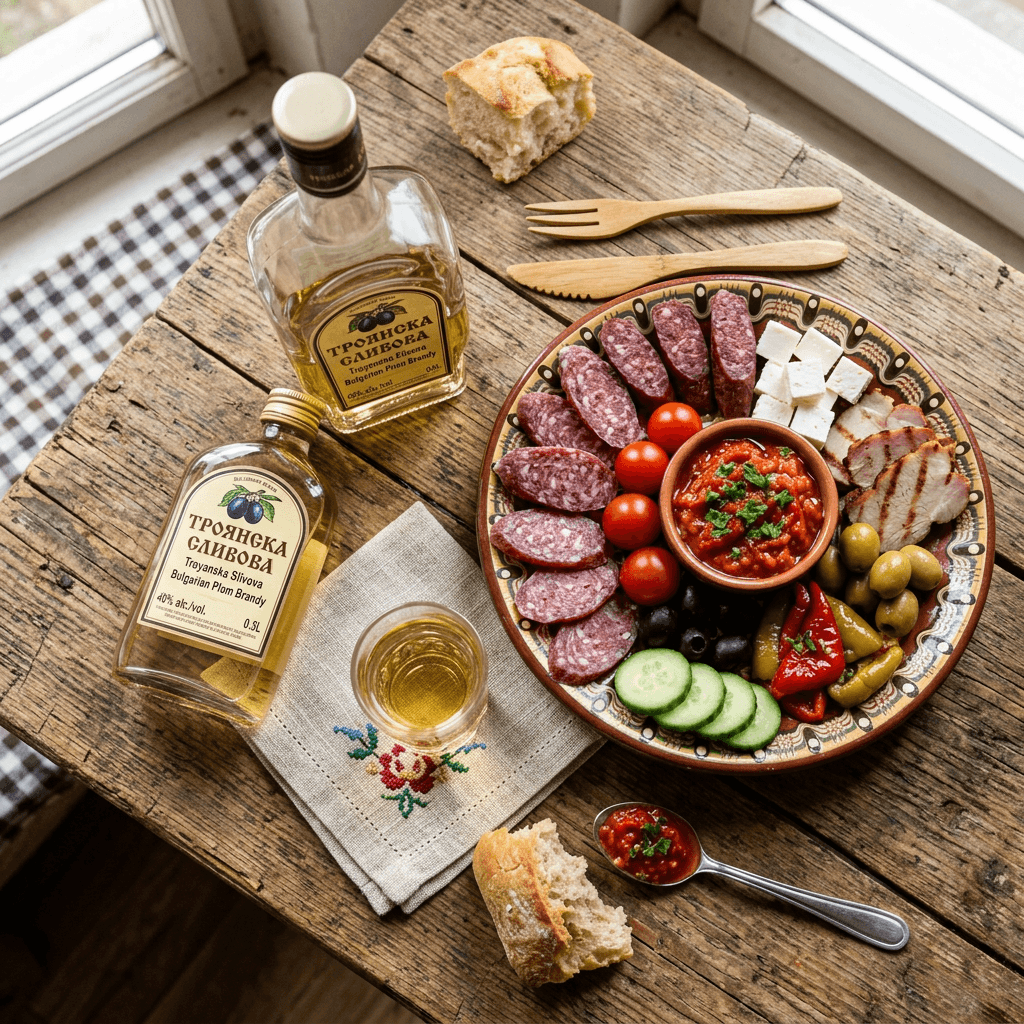
Meals in Bulgaria are long. It’s normal for a dinner with drinks to stretch three, four, even six hours - especially at someone’s home or during a celebration. Dishes arrive in waves. You order a round of meze and a carafe of rakia. Then maybe a salad. Then you switch to wine with the main course. Then back to rakia. The pace is deliberate. Nobody’s rushing.
This is a major reason why Bulgarians can drink as much as they do without falling apart by 10 PM. The constant eating, the slow sipping (never gulping), and the social nature of the table all work together. Getting visibly drunk is actually considered poor form. The goal is prolonged enjoyment, not annihilation.
If you’re wondering where locals drink in Sofia and how they spend a typical night out, we’ve written about that too.
Name Days: Bulgaria’s Bonus Drinking Holiday
Bulgarians don’t just celebrate birthdays. They also celebrate name days - and in many families, the name day is the bigger deal.
Every name in the Bulgarian calendar is linked to a saint’s day or religious holiday. If your name is Georgi, your name day is May 6th (St. George’s Day). Every Ivan in the country celebrates on January 7th. Maria? August 15th. And because so many Bulgarians share common names, certain name days turn into massive national celebrations. St. George’s Day, Palm Sunday (Tsvetnitsa, when everyone named after a flower or tree celebrates), and St. Nicholas Day on December 6th are practically public holidays.
The tradition works differently from a birthday party. Historically, name day celebrations were open-house events - you didn’t need an invitation. The person celebrating was expected to prepare food and drinks for whoever showed up. The old Bulgarian saying goes: “Na imen den ne se kani” - name days need no invitations. Today that tradition has relaxed, especially among younger people who tend to host name day gatherings at bars and restaurants.
What matters for you as a visitor is this: if you’re in Sofia on a major name day, bars and restaurants will be packed. And if a Bulgarian tells you it’s their name day, the appropriate response is “Chestit imen den!” (Happy name day) - and yes, there will probably be rakia involved.
How Much Does Drinking in Sofia Actually Cost?
This is where Sofia really stands out compared to Western Europe. A draft beer at a regular bar costs 4-6 EUR. Cocktails at a mid-range spot run 8-12 EUR, and even at the fanciest cocktail bars in town, you’re rarely paying more than 14 EUR. A 50ml glass of rakia at a restaurant is 4-6 EUR. A decent bottle of Bulgarian wine at a bar starts around 12-15 EUR.
You can have a full night out - three or four bars, several drinks at each - for somewhere between 40 and 70 EUR. Try doing that in London, Paris, or Amsterdam. You’d barely cover the first two rounds.
This is also why our pub crawl at 21 EUR is hard to argue with. That covers a welcome beer, three shots at different bars, and VIP club entry. You’d spend more than that buying the same drinks individually, and you wouldn’t get the local guide showing you the bars you’d never find on your own.
For a more detailed price breakdown covering taxis, club entry, and late-night food, we wrote a full guide on how much a night out in Sofia costs.
What to Drink Where: A Quick Sofia Cheat Sheet
Different drinks fit different settings in Sofia. Here’s how locals actually match them.
Rakia belongs at dinner - either at a traditional Bulgarian restaurant (called a mehana) or at someone’s home. Order it at the start of the meal alongside meze. Don’t order rakia at a nightclub unless you want confused looks from the bartender.
Wine works at dinner too, but it’s also the right call at Sofia’s growing number of wine bars. The Thracian Valley and Struma Valley regions produce the best bottles. Ask for something made from Mavrud, Melnik, or Rubin if you want the authentic Bulgarian experience.
Craft beer is for the afternoon-to-evening window. Hit the bars around NDK and Tsar Shishman Street. Pair it with pub food - banitsa (a cheese-filled pastry), french fries with grated sirene, or breaded mushrooms.
Cocktails come later in the evening at the best cocktail bars in Sofia, which have exploded in quality over the past few years.
Clubs are a rakia-free zone. Beer, vodka, and mixed drinks rule the dance floor. Sofia’s club scene opens late (midnight at the earliest) and runs until 5 or 6 AM. VIP club entry is included in our pub crawl, which saves you the cover charge and the awkwardness of choosing the wrong door.
How to Drink Like a Bulgarian: The Unwritten Rules
Bulgarian drinking culture has a logic to it, even if nobody writes it down. Here’s what will earn you respect at the table:
Sip, don’t slam. Rakia is sipped slowly. Wine is savoured. Even beer is drunk at a pace that allows conversation. Speed-drinking is seen as missing the point entirely.
Always eat while you drink. Order meze. Accept every plate that’s offered. If someone puts food in front of you, eat it. Declining food while drinking sends the wrong signal.
Look people in the eye during a toast. Every time. With every person. If someone says Nazdrave and you’re staring at your phone, you might as well have insulted their grandmother.
Don’t refuse the first glass. Especially if it’s homemade rakia offered at someone’s home. One glass is mandatory. After that, you can slow down. But declining the first pour is a rejection of hospitality.
Know the difference between drinking occasions. A quiet dinner with rakia and meze is not the same vibe as a Friday night bar crawl. Bulgarians adjust their drinking style based on context, and you should too.
Pace yourself. Bulgarian nights are long. If you’re out on a Sofia weekend trip, you want to make it through the whole evening. Start slow. The night doesn’t peak until well after midnight.
If you’re coming to Sofia as a solo traveller, the easiest way to experience all of this is to just show up to our pub crawl. Most people arrive alone. By the second bar, nobody is.
FAQ
What is the drinking age in Bulgaria?
The legal drinking age is 18, though enforcement at shops and restaurants is inconsistent. Bars and clubs in Sofia generally check ID for younger-looking visitors, especially at the door.
What is the national drink of Bulgaria?
Rakia is widely considered Bulgaria’s national drink. It’s a fruit brandy, typically made from grapes or plums, with an alcohol content between 40-60% depending on whether it’s commercially produced or homemade.
Is Bulgaria a heavy drinking country?
Bulgaria consistently ranks among the top countries in Europe for alcohol consumption per capita. But the culture around drinking is focused on social enjoyment with food rather than binge drinking. Getting visibly intoxicated is considered poor form in most social settings.
What does Nazdrave mean?
Nazdrave (Наздраве) is the Bulgarian word for “cheers.” It translates literally to “to your health” and is said before every toast. Proper etiquette requires eye contact with everyone at the table as glasses touch.
What food goes with rakia?
Traditional meze is the standard pairing: shopska salad, white brine cheese (sirene), lukanka (dry-cured salami), kyopolou (roasted pepper spread), and pickled vegetables. You should always have food on the table when drinking rakia.
What is Trifon Zarezan?
Trifon Zarezan is a Bulgarian holiday on February 14th honouring St. Trifon, the patron saint of vineyards and winemakers. It involves ritual vine pruning, wine-drinking, and celebrations that often overlap with Valentine’s Day.
Can I experience Bulgarian drinking culture on a night out in Sofia?
The easiest way is to join our Sofia pub crawl - we run it every Friday and Saturday at 9PM. For 21 EUR, you get a guided tour of four bars with drinks included and a local guide who’ll teach you the right way to say Nazdrave. Check out our full Sofia nightlife guide for more options.